
If you work out in Morocco, you’ve seen whey protein everywhere. It’s in gyms, pharmacies, and online. This is because it helps you meet your daily protein needs without extra cooking. It’s great for both newbies and seasoned gym-goers, helping repair muscles and grow them steadily.
The selection can be overwhelming. This guide simplifies the main types: whey concentrate, whey isolate, and hydrolyzed whey. Choosing between whey protein and hydrolyzed depends on your stomach, goals, and budget.
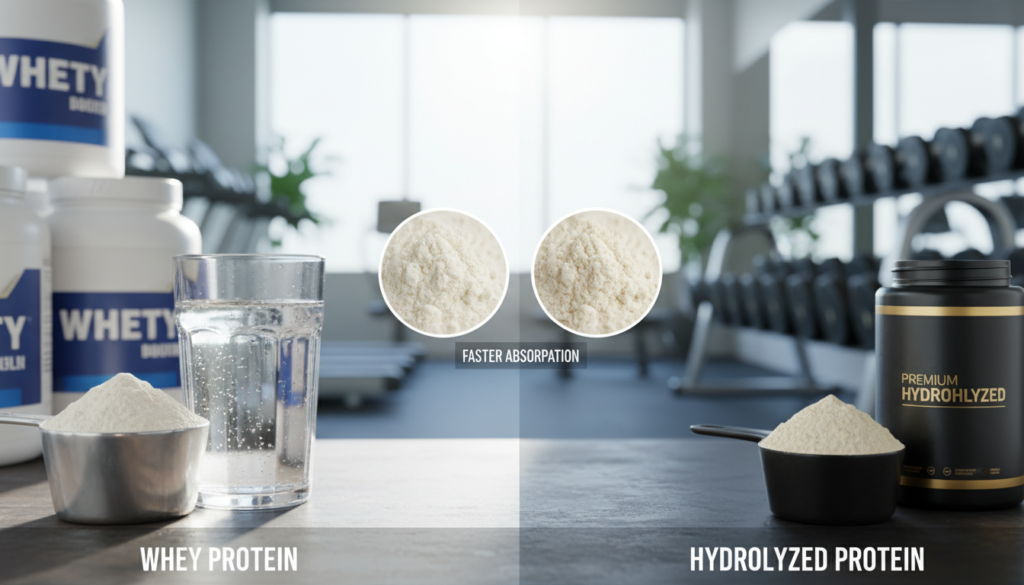
whey protein vs hydrolyzed protein
Think of it as a ladder of processing. Moving from whey concentrate to isolate to hydrolyzed means more protein, less carbs and fat, and less lactose. You might notice changes in taste, mixing, and label cleanliness, which is important when looking for protein powder in Morocco.
Hydrolyzed whey is marketed as fast-absorbing, but whey is already quick. In practice, hydrolyzed might only be a bit faster than isolate. Taste can be a trade-off, as more hydrolysis can make it bitter, which brands often mask with flavors and sweeteners.
Cost is also a factor in Morocco’s sports nutrition scene. Concentrate is the budget-friendly option, isolate is a step up but affordable, and hydrolyzed is the priciest. The best whey protein for muscle growth depends on your total protein intake, training, and recovery.
This article is for educational purposes only, not medical advice. If you have health concerns or milk allergies, consult a healthcare professional before using supplements.
Key Takeaways
- The main whey options are whey concentrate, whey isolate, and hydrolyzed whey.
- Choosing between whey protein and hydrolyzed depends on protein percentage, digestion, and cost.
- Whey concentrate vs isolate vs hydrolyzed means lower lactose and higher purity as processing increases.
- Hydrolyzed whey may be fast-absorbing, but whey isolate is already quick for most.
- Taste can vary; hydrolyzed whey can be more bitter than isolate or concentrate.
- For those shopping for protein powder in Morocco, the best value depends on budget, tolerance, and label clarity.
Whey Protein and Hydrolyzed Whey: What They Are and Where They Come From
If you’ve ever wondered, what is whey protein, it’s a key protein in milk. It contrasts with casein, making up the two main proteins in milk. Whey is the liquid part, while casein thickens and sets.
In Morocco, the journey of whey protein begins in dairy processing. This process transforms milk into cheese, explaining why whey ends up in your protein shakes.
Whey vs casein in milk and how cheese-making separates them
Milk naturally has more casein than whey. Cheese making uses an enzyme to create cheese making whey. This enzyme, often rennet, causes the milk to set into rennet casein curds.
The curds become the cheese base. The leftover liquid, whey, is rich in protein, lactose, minerals, and water. This liquid is the foundation for most whey supplements.
How liquid whey becomes protein powder through straining, heating, filtration, and drying
Many ask how whey protein is made from the liquid. First, the liquid is strained to remove solids. Then, it’s heated and processed to concentrate the protein and improve safety.
Next, filtration concentrates the protein by removing lactose and fat. Drying turns the concentrated whey into a stable powder that mixes well.
The three main whey forms on labels: concentrate, isolate, and hydrolyzed (whey hydrolysate)
Once whey is powdered, you’ll see three types. Concentrate is less filtered, keeping more of the milk’s components. Isolate is more filtered, increasing protein and reducing lactose.
Hydrolyzed whey has its protein structure changed. If you’re curious about whey hydrolysate meaning, it’s whey broken into smaller peptides. These variations aren’t separate products but different refinements of whey.
- Whey protein concentrate: retains more of the original whey.
- Whey protein isolate: has more protein, less lactose and fat.
- Hydrolyzed whey (whey hydrolysate): broken down into smaller pieces.
Comparing protein types: Whey Concentrate, Whey Isolate, and Hydrolyzed Whey
When you’re shopping in Morocco, the labels can seem like a secret code. You often face a big choice: whey concentrate vs isolate vs hydrolyzed. Each one suits different needs, budgets, and routines.
Think of it in three simple categories: WPC vs WPI vs WPH. They all come from whey but differ in processing. This changes their nutrients, taste, and cost.
whey concentrate vs isolate vs hydrolyzed
Whey concentrate (often listed as WPC) is the most common and affordable choice. It’s great for those who do well with dairy and don’t mind a bit more lactose and carbs.
But, WPC can vary a lot in protein percentage. So, always check the nutrition panel to meet your daily protein goals.
Whey isolate (WPI) is processed to remove more fat and carbs. It usually has 90%+ protein by weight, with very low lactose. This is good for those who get upset by milk sugar.
WPI is often cleaner and feels lighter after drinking. It’s a top pick for those who want more protein per scoop without extra calories.
Hydrolyzed whey (WPH) is made from isolate and broken down further. This creates smaller protein pieces for easier digestion. It’s often more expensive due to the extra processing.
Hydrolyzed whey is usually labeled as “whey hydrolysate” or “hydro whey.” It’s a WPH style.
Tri-blend whey formulas mix concentrate, isolate, and hydrolyzed in one product. THE Whey is a good example, marketed for training and post-workout use.
Blends offer a middle ground on cost, texture, and comfort. They’re a simple way to try different protein types without sticking to just one.
Nutrition Profile and Label Reading for Whey vs Hydrolyzed Protein Powders
When reading protein powder labels, remember: a scoop isn’t always the same. Brands use different sizes and formulas. So, the only fair way to compare is by looking at the serving size on the label. In Morocco, where prices vary a lot, checking the numbers first helps you avoid paying for fillers.
Protein concentration and what you get per scoop
Whey protein nutrition facts show a clear pattern. Whey concentrate usually has 50%–80% protein by weight. Whey isolate and hydrolyzed options are tighter and higher in protein.
Hydrolyzed whey macros can be similar to isolate. This is because many hydrolyzed products start as isolate. Hydrolysis breaks protein into smaller peptides, but it doesn’t automatically increase the protein grams on the label. What matters is how the product was filtered and how much flavoring was added.
Carbs, fat, and lactose: what changes and what doesn’t
Filtration is key to lower carbs and fat. When whey powder is filtered further to make isolate, it removes more non-protein parts. This often means lower lactose content whey, which is a big comfort upgrade for many.
Hydrolysis only works on the protein portion. It doesn’t remove carbs, fat, or lactose. So, if a hydrolyzed formula was made from an isolate base, its lactose content is often low. This comes from the isolate step, not hydrolysis.
Real-world macro examples and why they vary
Even within the same category, brands don’t match perfectly. One label may show 0 g carbs and 0 g fat, while another shows 1–2 g. These differences often come from the degree of filtration, added cocoa, creamers, or flavor systems.
- Illustrative per 20 g serving: Whey isolate: 72 calories, 17 g protein, 1 g carbs, 0 g fat, 80 mg calcium
- Illustrative per 20 g serving: Hydrolyzed whey: 73 calories, 15 g protein, 2 g carbs, 1 g fat, 80 mg calcium
When comparing whey isolate macros and hydrolyzed whey macros, always look at serving size, total calories, and the ingredient list. Don’t just look at the product name on the tub.
Ingredient and quality checks that matter
After looking at the numbers, scan the ingredient list for clarity. Look for whey protein concentrate (WPC), whey protein isolate (WPI), whey protein hydrolysate (WPH), or a blend. Blends can be useful, but they can also explain why carbs, fats, and lactose aren’t as low as expected.
For quality, look for a third-party tested protein powder claim and a clear testing approach on-pack. Many shoppers prefer grass-fed whey for sourcing and brand transparency. If sweeteners are included, watch out for how many are stacked, as hydrolyzed formulas often need stronger flavor masking.
Digestion, Absorption Speed, and Tolerability: Is Hydrolyzed Whey Actually Better?
If a protein powder makes you feel heavy or upset your stomach, the label is key. In Morocco’s heat, mixing whey with water is common. This makes taste and texture very important. Hydrolyzed and isolate products get a lot of attention here.
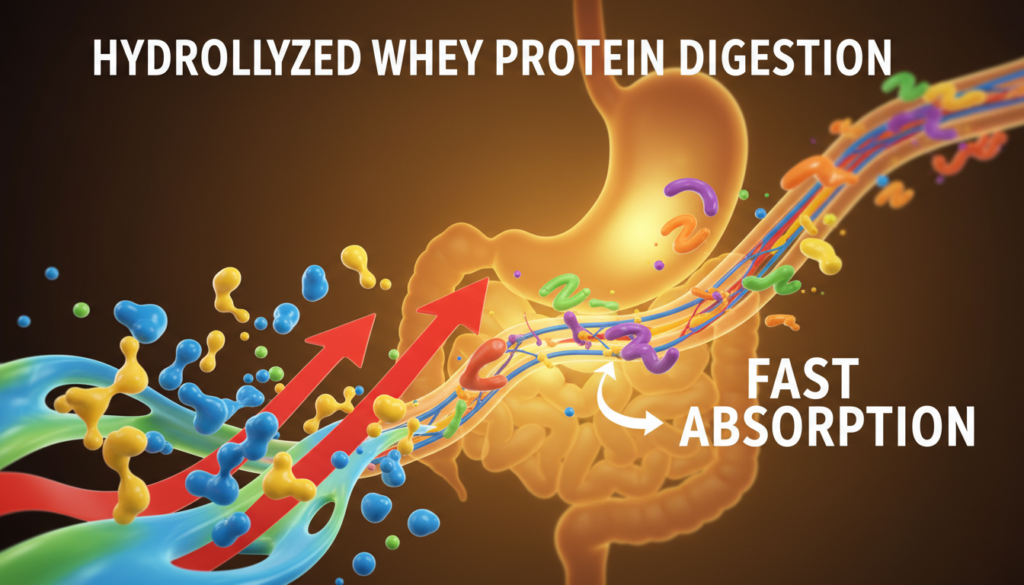
hydrolyzed whey digestion
Hydrolysis explained
Hydrolysis breaks down proteins into smaller chains using heat, acid, or enzymes. It’s thought to make digestion easier for your gut. But, your body must finish the digestion process.
Absorption reality check
Whey is known for quick absorption compared to whole foods. Hydrolyzed and isolate digestion speeds are similar. The difference is small, unless you’re not getting enough protein all day.
How much a protein is hydrolyzed also affects taste and benefits. Too much processing can harm flavor and effectiveness.
Bitterness and palatability
The bitter taste of hydrolyzed whey is real. Smaller peptides can taste sharp. Brands often use strong sweeteners to mask this.
Whey isolate is often smoother and cleaner. It’s better for clear, fruity mixes. It leaves less aftertaste, making it great for lemon or berry flavors.
Lactose sensitivity and digestive comfort
Most stomach issues with whey come from lactose and additives, not the protein. Concentrate has more lactose, causing bloating and gas in some.
For those with lactose intolerance, whey isolate is a better choice. Hydrolyzed whey is also low in lactose. But, always check the label for “low lactose” or “lactose-free” accuracy.
Allergy considerations
A milk allergy is different from lactose sensitivity. It’s an immune reaction to milk proteins, even in small amounts.
Some consider hydrolyzed whey for milk allergies because it’s broken down. But, it’s milk-derived. Always talk to a doctor before trying new powders.
Choosing the Best Option for Your Goal and Budget in Morocco
Finding the best whey protein in Morocco starts with two key questions: your goal and your stomach. The price of protein powder in Morocco can vary a lot. This depends on the store, size, and type of protein. So, it’s wise to compare labels carefully.
For strength training, most whey proteins work well if you stick to your plan. Whey isolate is often used in research for muscle gain. It provides all nine essential amino acids and BCAAs, with leucine helping with muscle building and recovery.
If you’re trying to lose fat, the type of whey you choose matters. Whey for fat loss is about keeping track of daily calories. A 2019 study found that whey can help with weight loss. Many choose isolate or hydrolyzed for their lower carb and fat content.
When it comes to post-workout timing, the debate is ongoing. But, daily protein and diet quality are more important than the exact timing of your shake. Hydrolyzed whey is popular for its quick absorption, even though whey is already fast to digest.
Budget is a big factor in your decision. Concentrate is usually the cheapest, isolate is in the middle, and hydrolyzed is the most expensive. This explains why hydrolyzed whey is pricier.
- Concentrate: good for everyday bulking, but protein content varies.
- Isolate: higher purity, better for those watching macros.
- Hydrolyzed: best for those who want fast absorption and easy mixing.
When shopping locally, focus on the details. Look at the protein percentage and whether it’s 100% isolate or a blend. Compare the macros of each serving. If you have digestion issues, check if the whey is lactose-free.
Taste is important too. Hydrolyzed whey can taste bitter and may have stronger flavors. Isolate often tastes cleaner. Choose products that are third-party tested and have clear labeling, including grass-fed options.
Conclusion
Choosing the right protein type depends on what you value most: cost, taste, or how it digests. All whey proteins have all nine essential amino acids and digest well. So, pick the one you can stick with every day.
In the debate between whey concentrate and isolate, concentrate is often cheaper and easier to find. But it may have more lactose and carbs. Isolate, on the other hand, is usually 90%+ protein, with less fat and lactose. It also tastes cleaner, which many prefer.
When comparing whey isolate to hydrolyzed whey, hydrolyzed whey is broken down into smaller peptides. This might make it easier on your stomach. It’s also the priciest and can taste bitter. A tri-blend like MYPROTEIN THE Whey offers a good balance of cost, taste, and comfort.
When shopping for protein powder in Morocco, match the product to your goals. Consider lactose tolerance, flavor, and budget. If you’re allergic to milk, hydrolyzed whey might be better. But always check with a doctor first. Make sure to check the macros, blend transparency, and any testing claims to ensure it fits your fitness plan.